
One of the more interesting developments in the stock market this year has been the relationship between stock prices and corporate earnings. Despite the S&P 500 remaining positive for the year, valuations have actually contracted as earnings expectations have grown faster than stock prices. In other words, investors are paying less for each dollar of expected earnings today than they were at the beginning of the year, even though the market itself has moved higher.
I think that’s an important distinction getting lost in the recent headlines, particularly as investors have become increasingly concerned about the enormous amounts of money being spent on artificial intelligence.
For the past several years, investors had been willing to pay increasingly high valuations for companies benefiting from the AI investment boom. But as interest rates have risen and the cost of capital has increased, the market has become much more cautious about how much it’s willing to pay for future growth. Investors are beginning to question whether the hundreds of billions of dollars being spent building data centers and purchasing computing equipment will ultimately generate attractive returns, particularly when those returns may take years to materialize. Companies relying heavily on debt to finance that spending have come under even greater pressure.
We actually think some of this skepticism is healthy. Higher interest rates should force companies to be more disciplined about how they allocate capital, and investors should be asking harder questions about the returns on those investments. Not every company participating in the AI buildout will be a winner, but there’s an important difference between investors becoming more cautious about the price they’re willing to pay for growth and the underlying growth itself deteriorating.
EARNINGS GROWTH IS DOING THE HEAVY LIFTING
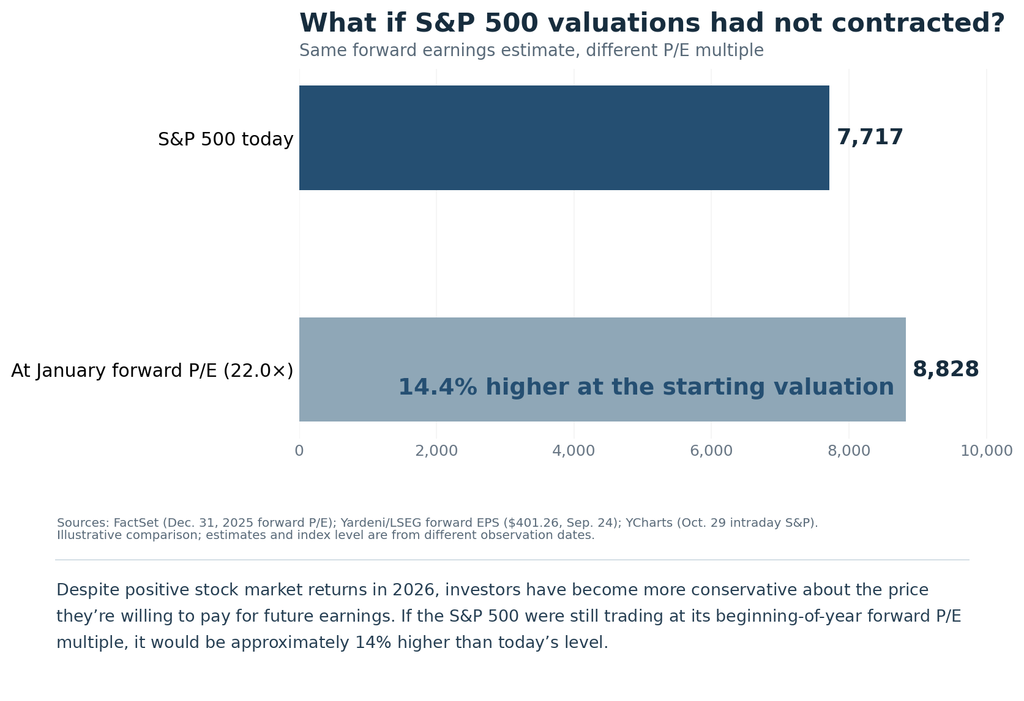
One way to illustrate this is to look at where the S&P 500 would be trading today if investors were still willing to pay the same valuation they were at the beginning of the year.
At the start of 2026, the S&P 500 traded at approximately 22 times expected forward earnings. Using the latest forward earnings estimate of roughly $401 per index share, the S&P 500 would be trading near 8,828 if that valuation had remained unchanged. Instead, the index is trading around 7,716, roughly 14% below where it would be under that scenario.
Despite positive stock market returns this year, investors have become more conservative about the price they’re willing to pay for future earnings. That’s a very different environment from one where stock prices are rising simply because investors are willing to pay increasingly higher multiples. It doesn’t mean stocks are inexpensive by historical standards, but it does suggest that earnings growth, rather than expanding valuations, has been driving the market higher.
THE ECONOMIC BACKDROP REMAINS ENCOURAGING
And it’s not just corporate earnings giving us reasons to remain optimistic. Initial jobless claims have remained below 200,000 for seven consecutive weeks, suggesting businesses are still reluctant to lay off workers. Consumer spending has also been incredibly resilient, something we’ve seen repeatedly in recent earnings reports from major banks and credit card companies. Meanwhile, GDP growth continues to show strength despite persistent inflation and higher interest rates.
Looked at together, these aren’t the economic conditions we would typically associate with an economy heading into a significant downturn. There are certainly areas of weakness, and we wouldn’t suggest that contracting valuations eliminate the possibility of a market correction. But as we move toward the end of the year, we find it encouraging that earnings growth has been doing more of the heavy lifting while investors have become more disciplined about valuations.
A HISTORICALLY FAVORABLE SETUP FOR STOCKS
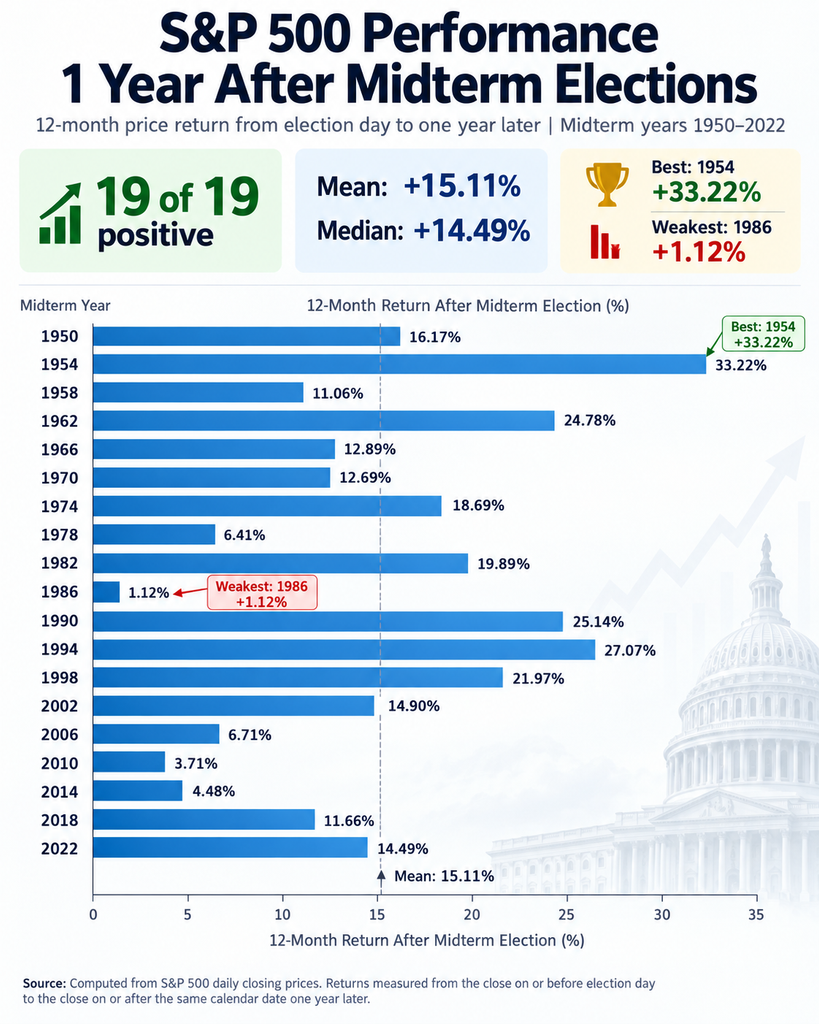
We’re also about to enter what has historically been one of the strongest seasonal periods for the stock market, as we move beyond the uncertainty surrounding the midterm elections. Since 1950, the S&P 500 has been positive in the 12 months following every midterm election, a perfect 19 out of 19 record. While history certainly can’t predict we’ll make it 20 out of 20, we think the current economic backdrop gives us plenty of reasons to be optimistic about the year ahead.
With a resilient labor market, continued consumer spending, solid economic growth, and corporate earnings holding up, we believe the underlying fundamentals provide a strong foundation for markets as we move beyond election uncertainty and into a historically favorable period for stocks.