
Inflation remains above target, the economy has remained resilient, and lessons from 2022 and 1999 offer useful context for investors today.
Last week, the Federal Reserve raised interest rates by 0.25%. On the surface, that might seem surprising. The Fed had spent the past couple of years gradually lowering rates, and now it is reversing course. The Fed said economic activity was still expanding at a solid pace, domestic spending remained resilient, capital investment was robust, and inflation remained elevated.
But given the economic backdrop, I think the case for the hike was fairly straightforward.
Inflation remains well above the Fed’s 2% target, while the underlying economy has continued to hold up reasonably well. Higher oil prices related to the war in Iran have certainly added to inflationary pressure, but energy is not the whole story. The Fed’s preferred PCE inflation measure was running at 3.7% in July, with core PCE still at 3.3%.
In other words, this does not look like an economy that obviously requires easier monetary policy.
There is also an important lesson from the last inflation cycle. In 2022, the Fed found itself badly behind inflation and was forced to catch up quickly. The federal funds rate went from essentially zero to more than 4% in less than a year and eventually above 5%.
That pace of tightening put enormous pressure on financial markets and brought the economy uncomfortably close to recession.
The risk today is different. A modest increase in rates now may reduce the odds that the Fed has to make much more aggressive moves later if inflation becomes entrenched again.
That distinction is particularly important for bond investors.
Why This Isn’t the Bond Market of 2022
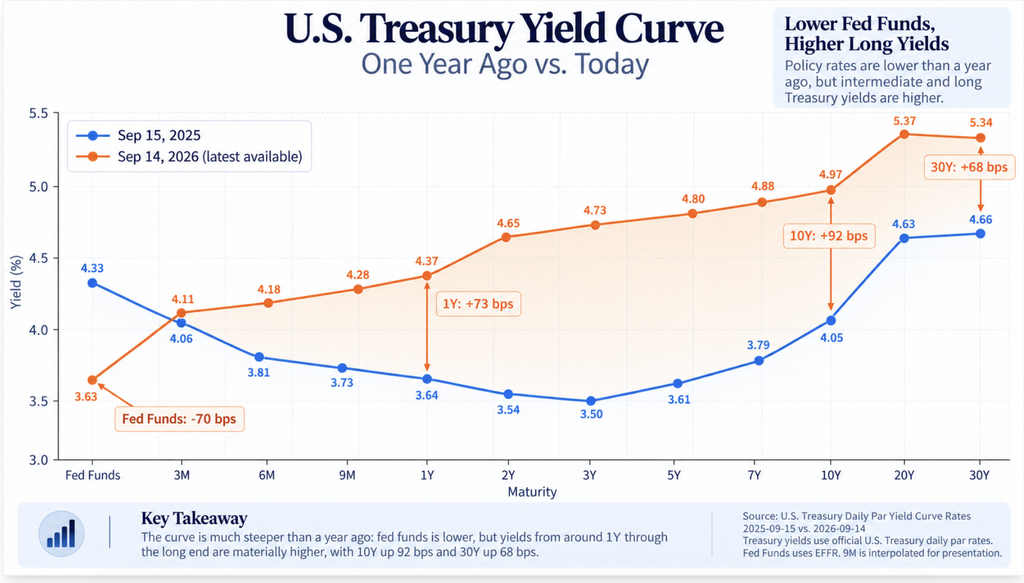
The chart above may be the most important one for investors today.
Over the past year, short-term Fed policy became easier, but intermediate and long-term Treasury yields moved substantially higher. The 10-year Treasury rose from roughly 4.05% to nearly 5%, while the 30-year moved from about 4.66% to more than 5.3%.
That has created a much different opportunity set for investors holding cash.
In 2022, investors were taking duration risk when bond yields were still historically low. When the Fed began aggressively raising rates, bond prices had a long way to fall. A long-term bond yielding 1% or 2% offered very little income to cushion the decline in price as rates reset higher.
Today the starting point is very different.
Investors can now earn yields of about 5% across meaningful portions of the Treasury market. That does not eliminate interest-rate risk. Long-term bonds can still decline if yields rise further, but starting yield matters enormously.
We have been using this environment to continue repositioning portions of cash where appropriate and taking advantage of better yields.
The key point is that going from near-zero rates toward 5% is very different from moving rates modestly higher when much of the bond market is already yielding around 4% to 5%.
That is why I don’t think comparisons to the bond market of 2022 are particularly useful.
A Lesson From the Late 1990s
There is another historical period that has been on my mind lately.
Following the Russian financial crisis and the near-collapse of Long-Term Capital Management in 1998, the Federal Reserve cut rates three times as a form of insurance against broader economic weakness. But the economy remained strong.
So in 1999, the Fed began taking those cuts back. It raised rates in June, August and November, bringing the federal funds rate back to 5.5%. You might assume that would have ended the technology rally, but it didn’t
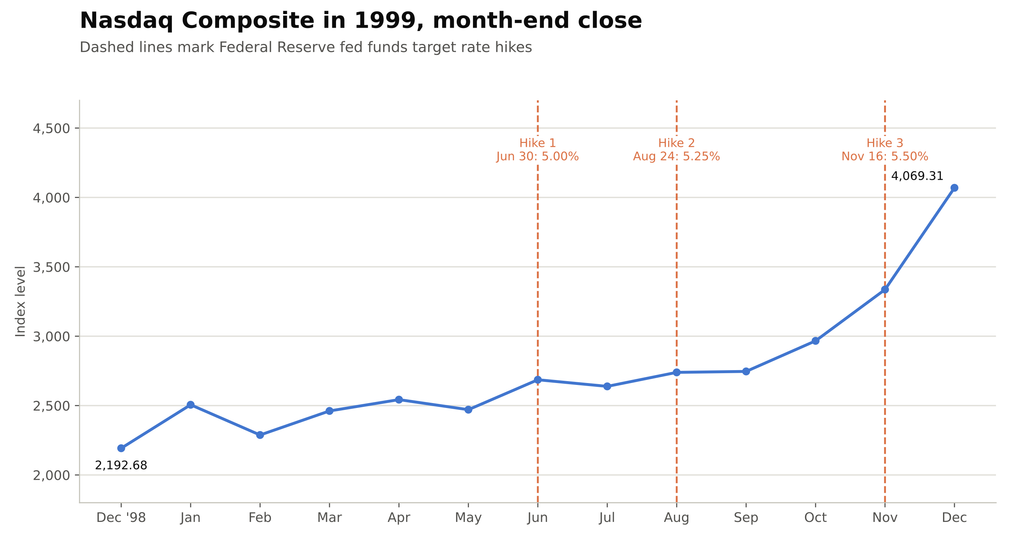
The Nasdaq began 1999 around 2,193 and finished the year above 4,069, an increase of roughly 86%. The chart shows that the market continued climbing through all three Fed hikes.
What makes that period even more striking is how expensive technology stocks already were. Nasdaq estimates that the Nasdaq-100 was trading above 100 times trailing earnings around the end of 1999, compared with valuations in roughly the low 30s in the more recent period. Valuations became even more extreme as the technology bubble approached its peak in early 2000.
Yet even from those already elevated valuations, three Fed rate hikes in 1999 did not immediately end the rally. The Nasdaq still had a remarkable amount of upside left after the first hike in June before ultimately peaking in March 2000.
Of course, we know how that story ended. Technology valuations eventually became unsustainable, the bubble burst, and the Nasdaq suffered an enormous decline.
So the takeaway is not that Fed hikes are bullish, or that today’s market is destined to repeat 1999. Market conditions then differed materially from today, including a technology sector that was trading at far more extreme valuations.
The lesson is simpler:
The direction of the federal funds rate alone does not determine the direction of the stock market.
Markets can continue rising while the Fed is tightening if earnings, economic growth, productivity and investment remain strong enough. In 1999, rate hikes were not even enough to immediately derail a market rally that was already considerably more expensive than today. Eventually, regardless of what the Fed is doing, valuation still matters.
That feels particularly relevant today as investors debate whether higher rates automatically spell trouble for a market being driven in part by enormous investment in artificial intelligence and technology infrastructure.
What Matters From Here
There are a few stories unfolding at the same time, impacting stocks, bonds and cash differently.
Inflation remains too high for the Fed to comfortably declare victory, while the economy has remained strong enough to tolerate tighter policy. At the same time, higher market interest rates have created considerably better opportunities for investors who have accumulated cash.
For the first time in many years, investors do not necessarily have to choose between earning almost nothing in safe assets and reaching aggressively for return elsewhere. High-quality bonds can once again provide meaningful income.
And for equity investors, history is a useful reminder that a Fed hike by itself tells us surprisingly little about where stocks go next.
For now, investors are focused on the Fed, inflation, the war and renewed AI fears, but with markets in the lull before earnings season begins again in October, the next round of corporate results will likely tell us far more about the direction of markets than any of those headlines.